
What does RV rental cost per week really include?
Base rental price versus all-in trip cost
An advertised $150 nightly rate suggests a $1,050 base price for seven nights. That figure is only a starting point. A weekly discount, minimum-stay pricing, date-specific rates, or required charges may mean the base price is not simply seven times the displayed nightly rate.
Build the all-in trip cost from these layers:
- Seven-night base rental price
- Mileage overage and generator-hour charges
- Insurance or a protection plan
- Service, cleaning, delivery, setup, and pet fees
- Taxes
- Fuel and propane
- Campground fees
- Required dumping or refill charges
A refundable security deposit increases the cash or available credit needed, but it is not expected trip spending if all return conditions are met. The RV Rental Cost Index provides broader planning context for comparing costs.
Why every weekly quote is different
RV type, location, travel dates, route length, and provider policies all affect the final price. A compact camper van may use less fuel, while a larger motorhome may carry more people. A travel trailer requires a suitable tow vehicle, and a delivered RV can add delivery and setup charges while avoiding road mileage.
Peak dates, included miles, generator allowances, insurance options, and owner or fleet rules can also change the total. Compare identical dates, travelers, route miles, pets, and add-ons. Before booking, confirm live availability, request a current itemized quote, and review the provider’s cancellation, deposit, damage, and return terms.
Typical weekly RV rental base rates by RV type
A seven-night base rental can range from roughly $500 for some towable RVs to more than $2,800 for larger or premium motorhomes. These figures are broad planning ranges, not local quotes. They exclude mileage, generator use, insurance or protection plans, taxes, cleaning, fuel, campsites, delivery, setup, and refundable deposits.
| RV type | Broad seven-night base range | Common trip fit | Driving or towing requirement |
|---|---|---|---|
| Travel trailer | $500-$1,400 | Couples or families | Compatible tow vehicle and equipment |
| Fifth wheel | $700-$2,100 | Families wanting more interior space | Properly equipped pickup with fifth-wheel hitch |
| Class B camper van | $700-$2,100 | 1-2 adults prioritizing maneuverability | Driven by renter |
| Class C motorhome | $1,000-$2,400 | Families or small groups | Driven by renter |
| Class A motorhome | $1,400-$2,800+ | Groups wanting maximum living space | Driven by renter |
| Delivered RV | $500-$2,800+ | Stationary campground stays | Provider delivers the underlying RV type |
Sleeping capacity, seat-belt positions, amenities, and weekly discounts vary by unit. Seven nights may also have a separate weekly price rather than equal seven times the advertised nightly rate.
Class A, Class B and Class C motorhomes
All three are motorized RVs. Class A motorhomes resemble buses and usually offer the most interior room, but they can cost more and require confidence with a large vehicle. Class B camper vans are compact, easier to park, and best suited to travelers comfortable with limited storage and bathroom space. Class C motorhomes have a truck-style cab with an over-cab sleeping area, balancing family capacity with more familiar handling.
Travel trailers and fifth wheels
Travel trailers and fifth wheels are towable RVs, so their lower base rates do not automatically make them cheaper. Before comparing prices, verify the tow vehicle’s towing capacity and payload plus the required receiver, hitch, brake controller, and electrical connection. Account for loaded tongue weight on a travel trailer or pin weight on a fifth wheel, not only the RV’s empty weight.
Delivered RV rentals
A delivered RV rental is placed at a campsite and usually is not driven by the renter. Its base rate depends on the underlying trailer or motorhome. Check the separate delivery and setup fee, service radius, campsite size, hookups, and responsibility for tank dumping and propane. Review the RV delivery guide and confirm the current itemized quote, availability, and terms directly with the provider.
Seven-night RV rental calculation - from nightly rate to final budget
An advertised nightly rate is only the first line of a seven-night budget. The worksheet below uses hypothetical figures for illustration, not a local quote. Replace every amount with the provider’s current itemized charges.
Calculate the seven-night base rate
Start with the displayed rate:
$175 per night x 7 nights = $1,225 base rate
That calculation works only if the same rate applies to every night. Weekend pricing, holiday rates, minimum stays, seasonal adjustments, and owner-specific rules can change the result. Some providers also display an average nightly rate derived from the total booking price.
Use the checkout subtotal, not the search-page rate, when comparing rentals. Booking seven nights does not always equal seven times the advertised nightly rate.
Apply the weekly rental discount correctly
Suppose the provider offers 10% off the seven-night base charge:
$1,225 x 10% = $122.50 discount
$1,225 - $122.50 = $1,102.50 discounted base price
Another rental might show a separate weekly price of $1,075. In that case, compare $1,075 directly with the $1,102.50 discounted result. Do not apply another 10% unless the provider confirms that the offers can be combined.
A weekly discount often applies only to the rental charge. It may not reduce insurance, protection plans, service fees, taxes, mileage, generator use, cleaning, or optional equipment.
| Illustrative budget item | Assumed amount |
|---|---|
| Discounted seven-night base price | $1,102.50 |
| Mileage overage | $120 |
| Protection plan | $210 |
| Service fee | $175 |
| Cleaning fee | $100 |
| Taxes | $132.50 |
| Fuel estimate | $325 |
| Campground estimate | $350 |
| Estimated all-in trip cost | $2,515 |
| Refundable security deposit | $500 |
The $500 deposit raises the temporary cash or credit requirement to $3,015, but it is not expected spending if the RV meets all return conditions. Confirm deposit authorization, release timing, and possible deductions directly with the provider.
Account for pickup and return timing
Seven paid nights do not necessarily provide seven full travel days. A 3:00 PM pickup may include an orientation, inspection, paperwork, and loading time. An 11:00 AM return can require an early departure, refueling, tank dumping, and cleaning.
Compare the actual usable travel window along with the charged dates. A slightly higher quote with earlier pickup or later return may offer more practical trip time, although schedules and late-return policies vary. The daily RV rental cost guide provides additional context for evaluating the effective cost per usable day.
Budget for mileage, generator hours and fuel
Usage-based charges can materially raise the all-in trip cost beyond the advertised nightly rate. Estimate them before comparing weekly rentals, then replace every assumption with the mileage, generator, and fuel terms shown in the provider’s current itemized quote.
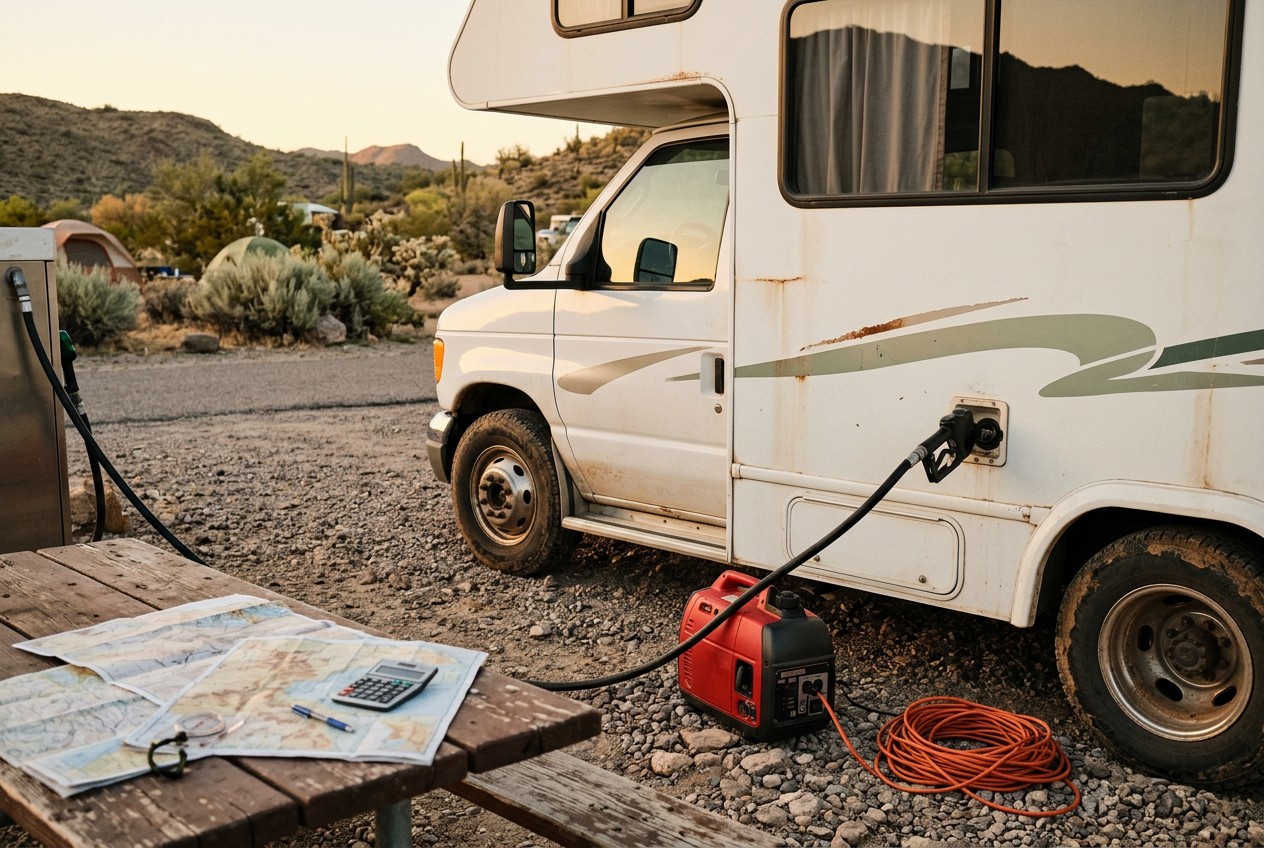
Estimate mileage allowance and overage fees
First, map the complete route and add a buffer for grocery runs, campground access roads, sightseeing, and detours. A 10% mileage buffer is a reasonable planning assumption, but adjust it to your itinerary.
Use these formulas:
Planned route miles x 1.10 = buffered route miles
Buffered route miles - included mileage = billable excess miles
Billable excess miles x overage rate = estimated mileage charge
For example, a 1,050-mile route becomes 1,155 miles with a 10% buffer. If the rental includes 700 miles, the excess is 455 miles. At an illustrative $0.45 per mile:
455 miles x $0.45 = $204.75
If the result is negative, budget $0 for overage. Confirm whether included mileage is calculated per night, per day, or for the entire reservation.
Find the unlimited mileage break-even point
Compare the unlimited-mileage upgrade with expected overage charges under the limited plan:
Unlimited-mileage upgrade cost / per-mile overage rate = break-even excess miles
Suppose unlimited mileage costs an additional $300 and the standard overage rate is $0.50 per mile:
$300 / $0.50 = 600 excess miles
The upgrade begins to cost less once expected excess mileage exceeds 600 miles. Below that point, the limited plan may cost less. Read the unlimited mileage guide and verify route restrictions, excluded destinations, and other provider conditions before choosing.
Calculate generator and fuel costs separately
Generator hours are not the same as road fuel. If 28 hours are included, expected use is 35 hours, and the illustrative overage charge is $4 per hour:
7 excess hours x $4 = $28
Confirm how hours are measured, whether unused allowances carry across days, and whether generator fuel is drawn from the vehicle’s tank.
Estimate driving fuel with:
Route miles / expected miles per gallon x current fuel price = road-fuel cost
For 1,155 miles at 10 mpg and $3.50 per gallon:
1,155 / 10 x $3.50 = $404.25
Use current prices along your route and realistic fuel economy for the loaded RV. Ask separately about generator fuel, propane refill requirements, return fuel level, and related charges. Policies and rates vary by owner, fleet, and location, so confirm all allowances and terms directly before booking.
Insurance, fees and deposits that affect the weekly total
RV rental insurance and protection plans
RV rental insurance generally means a policy covering specified risks during the booked period. A protection plan may instead be a contractual product that limits responsibility for certain damage. Do not assume they provide identical benefits. Roadside assistance handles operational problems such as breakdowns, flat tires, lockouts, or towing, subject to separate limits and exclusions.
Compare:
- Exact coverage start and end times
- Deductible and renter damage responsibility
- Excluded drivers, uses, roads, and destinations
- Coverage for the roof, awning, interior, tires, and glass
- Whether roadside assistance is included or separately priced
Do not assume a personal auto policy or credit card covers a motorhome or towable RV. Verify directly with the insurer, card issuer, and rental provider. See the RV rental insurance guide for additional questions to ask.
Service, cleaning and trip-specific fees
Checkout charges can increase the weekly total even when two rentals have similar advertised nightly rates. Review each line for:
- Service or booking fees
- Standard or condition-based cleaning fees
- Pet charges and required pet deposits
- State and local taxes
- Propane refill and fuel requirements
- Holding tank dumping charges
- Delivery and setup fees
- Required equipment or other add-ons
A service fee may be fixed or percentage-based. Cleaning might be charged upfront, assessed only if return standards are not met, or split into standard and excessive-cleaning charges. Dumping, propane, damage, and late-return charges may be assessed after the RV is returned.
The RV rental fees guide explains common charge categories. Confirm which fees are mandatory, optional, conditional, taxable, or refundable using the provider’s current itemized quote.
Refundable security deposits are cash required, not trip spending
Keep the refundable security deposit separate from the estimated all-in trip cost. It temporarily increases the cash or available credit required at booking or pickup, but it is not expected spending if every return condition is satisfied.
Ask whether the deposit is charged or placed as an authorization hold, when it will be released, and what can be deducted. Review rules covering damage, cleaning, fuel, propane, dumping, missing equipment, and late returns. Release timing and dispute procedures vary, so confirm the current terms directly before booking.
Compare weekly RV rental quotes on equal terms
Use one quote worksheet for every rental
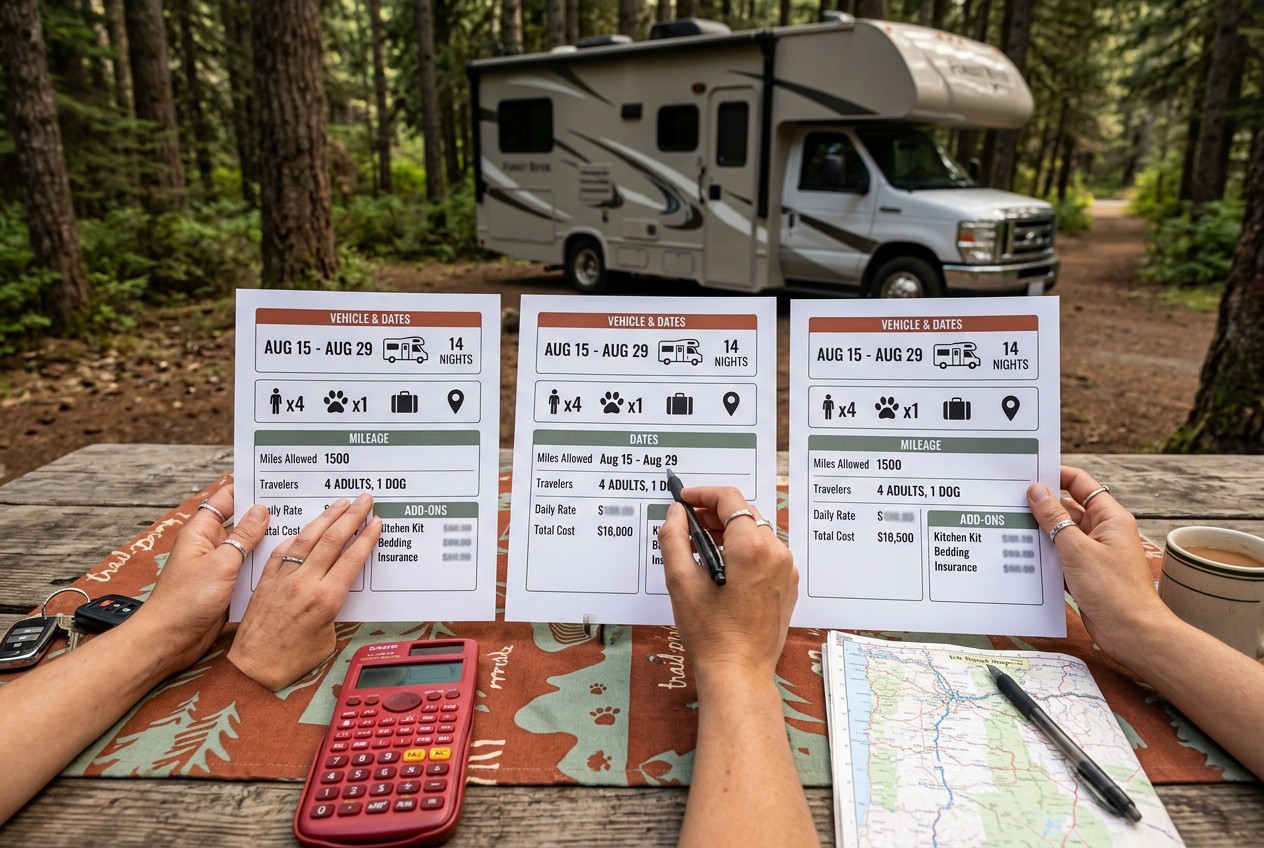
Set identical dates, pickup and return times, route miles, travelers, pets, and add-ons before comparing RV rental listings. Copy the worksheet for each candidate.
| Worksheet line | What to record | Budget treatment |
|---|---|---|
| Base rental | Seven-night price and weekly discount | Expected cost |
| Mileage | Included miles, excess miles, and overage rate | Expected cost |
| Generator | Included hours and hourly overage rate | Expected cost |
| Coverage | Insurance or protection plan and roadside assistance | Expected cost |
| Fees | Service, cleaning, taxes, equipment, and pet charges | Expected cost |
| Trip expenses | Fuel, propane, campgrounds, and dumping | Estimated cost |
| Deposit | Refundable security deposit or authorization hold | Temporary cash required |
Add each expected expense to calculate the all-in trip cost. Keep refundable amounts in a separate column so they do not make one rental appear more expensive, while still accounting for the cash or available credit needed.
Check delivery, campsite and hookup responsibilities
For a delivered RV, compare the delivery and setup fee, service-area or distance limits, and pickup arrangements. Confirm that the campground permits the RV type and that the site accommodates its length, width, and slide-outs.
Check the electrical connection, including amperage, plus water and sewer availability. Ask who connects the hookups, supplies or refills propane, dumps the holding tanks, and prepares the RV for provider pickup. Campground charges remain separate from the advertised nightly rental rate.
Review terms before paying
Use this final checklist:
- Cancellation rules and payment schedule
- Pickup, return, and late-return terms
- Cleaning, fuel, propane, and dumping requirements
- Pet restrictions and charges
- Damage responsibility and deductible
- Insurance or protection-plan exclusions
- Roadside-assistance coverage
- Deposit amount, deductions, and release timing
Prices, availability, and policies vary by owner, fleet, and location. Obtain the current itemized quote directly from the provider and confirm every mandatory, optional, conditional, and refundable charge before booking.
Is a weekly RV rental cheaper than a hotel?
Compare complete seven-day trip budgets
A lower advertised nightly rate does not identify the cheaper trip. Compare the same dates, destinations, group size, and meal plan, then total every expected expense.
| RV trip | Hotel trip |
|---|---|
| Base rental and weekly discount | Enough rooms for every traveler |
| Mileage and generator charges | Room taxes and mandatory fees |
| Insurance or protection plan | Parking fees |
| Service, cleaning, and pet fees | Rental car, rideshare, or transit |
| Fuel and propane | Fuel and tolls |
| Campground fees | Comparable meal costs |
| Dumping or delivery charges | Resort or destination fees |
An RV may work well for a family that would otherwise need two hotel rooms, especially when travelers prepare several meals. A hotel may cost less for a couple driving a fuel-efficient car, staying in one room, or visiting cities where campgrounds are distant and local transportation is necessary.
Route length also matters. A motorized RV adds fuel and possible mileage charges, while a delivered RV avoids renter-driven mileage but may add delivery and setup fees. Campground selection can change the result substantially. Compare the full seven-day budget, not just lodging prices.
Ways to reduce the weekly cost
- Compare flexible dates and avoid peak-season pricing when practical.
- Choose the smallest RV that safely fits the travelers, seat-belt needs, and sleeping arrangements.
- Plan a shorter route to reduce fuel and mileage overage.
- Skip equipment packages and other paid add-ons you will not use.
- Compare weekly discounts against the complete itemized total.
Do not estimate a two-week or long-term rental by simply multiplying one weekly rate. Providers may apply different discounts, mileage allowances, fees, or insurance pricing for longer bookings. Confirm current availability, the itemized quote, and all provider terms before paying.
Weekly RV rental cost FAQ
How much does it cost to rent an RV for seven days?
A seven-night base rental may range from roughly $500 to more than $2,800, depending on RV type, dates, and location. The advertised rate usually excludes mileage, insurance or a protection plan, fuel, campgrounds, taxes, and fees. Review the complete RV rental cost guide when building an all-in trip budget.
How can I make a weekly RV rental cheaper?
Compare flexible dates, choose the smallest RV that safely fits your group, and plan a shorter route to limit fuel and mileage charges. Check whether a weekly discount beats seven nightly charges, but confirm which fees it covers. Decline optional add-ons only when you are certain they are unnecessary.
What hidden fees should I check before booking?
Look for mileage overage, generator use, service, cleaning, delivery, setup, dumping, propane, pet, insurance, and tax charges. Some are mandatory, while others depend on usage or return condition.
Keep a refundable security deposit separate from expected spending, although it still increases the cash or available credit required. When comparing an RV with a hotel, include campsites, fuel, transportation, parking, rooms, and comparable meals. Prices, availability, and policies vary, so confirm the current itemized quote and provider terms before booking.
Travel safety: Sleeping capacity is not the same as safe travel capacity. Every occupant must use a designated seat with an appropriate seat belt or child restraint, and no one should ride inside a towable trailer while it is moving.
Towing safety: Never exceed the tow vehicle, trailer, axle, tire, hitch, payload, tongue-weight, or pin-weight ratings. Use all legally required brakes, safety chains, breakaway equipment, mirrors, and electrical connections, and seek professional assistance if you are not experienced with towing setup.
Generator and fuel safety: Operate generators only as directed by the manufacturer, outdoors and well away from doors, windows, vents, and occupied areas. Keep working carbon-monoxide alarms in the RV, and shut down and cool equipment before refueling.
Hookup and sanitation safety: Use properly rated, undamaged electrical and utility equipment and follow campground and manufacturer procedures. Keep potable-water hoses and fittings separate from sewer equipment, use appropriate protective gloves when handling waste systems, and wash your hands afterward.
Legal requirements vary by location. Confirm driver-license and age requirements, towing and trailer-brake laws, equipment rules, route restrictions, campground policies, and the rental provider’s eligibility terms before booking or operating the RV.