What First-Time RV Renters Need to Know
A first-time RV rental starts with six choices: RV type, floor plan, total trip cost, driving or towing responsibility, campsite compatibility, and trip length. A recreational vehicle can be a motorhome you drive, a trailer you tow, or a unit delivered directly to a campsite.
Compare available RV listings and RV rental types by usable space, not just advertised sleeping capacity. Check the actual beds, seat belts, bathroom layout, storage, and privacy. Also confirm the vehicle’s length, height, required hookups, and space needed for slide-outs.
Do not treat the advertised nightly rate as the final price. Request an itemized quote that includes mileage, generator hours, fuel, insurance or a protection plan, taxes, cleaning, campground charges, delivery, setup, dumping, and any refundable security deposit. Prices and policies vary by owner, fleet, vehicle, and location, so confirm current written terms directly with the provider before booking.
Self-Drive, Towable, or Delivered?
| Rental format | Your responsibilities | Key first-trip consideration |
|---|---|---|
| Self-drive motorhome | Drive, park, level, connect hookups, and manage wastewater | Easier than towing for many renters, but size affects clearance and handling |
| Travel trailer | Provide a compatible tow vehicle, hitch and brake equipment, tow safely, level, and connect utilities | Confirm towing capacity, payload, trailer brakes, and campsite access |
| Delivered RV | Travel separately while the provider transports the RV | Confirm who handles leveling, hookups, setup, teardown, and wastewater |
For a first trip, a shorter route with fewer campground changes leaves more time to learn the systems. Before reserving, verify site length, electrical service, water and sewer access, arrival procedures, and any generator restrictions.
Which Type of RV Is Best for a First Rental?
The best first rental depends on who is traveling, where everyone will sleep, and how comfortable the driver is with a larger vehicle or trailer. Compare the practical differences before choosing:
| RV type | Driving difficulty | Sleeping space | Campsite needs | Bathroom access | First-time fit |
|---|---|---|---|---|---|
| Class A motorhome | Highest due to width, length, and large turning radius | Usually generous, with multiple beds and substantial storage | Often needs a longer site and room for slide-outs | Commonly a full bathroom | Best for drivers comfortable with large vehicles |
| Class B camper van | Usually easiest motorhome to maneuver and park | Best for 1-2 people, though some sleep more | Fits many smaller sites and may have fewer hookup needs | Often a compact wet bath or portable toilet | Strong choice for couples and short trips |
| Class C motorhome | Moderate, with truck-style controls but extra width and rear overhang | Often suitable for couples or families, including an over-cab bed | Requires length and clearance checks | Usually a dedicated bathroom | Practical middle ground for many first renters |
| Travel trailer | Towing and backing require practice | Varies from compact layouts to family bunkhouses | Needs a suitable site plus space for the tow vehicle | Common in larger models | Good only with a properly equipped tow vehicle and confident driver |
| Delivered RV rental | No driving or towing by the renter | Depends on the unit and floor plan | Must fit the reserved site and available hookups | Varies by unit | Often easiest for a campground-based first trip |
Class A, Class B, and Class C Motorhomes Compared
A Class A is the bus-shaped option. It typically offers the most interior room, passenger space, and storage, but its width and length can make fuel stops, parking, narrow roads, and campground positioning more demanding.
A Class B is a camper van. It is generally easier to drive and park, but the tradeoff is limited storage, compact beds, and a small bathroom. Some units have a wet bath, where the toilet and shower share one waterproof compartment.
A Class C has a van or truck cab with a living area behind it, often including a bed above the cab. It can provide more sleeping space than a camper van without feeling as large as many Class A models. Watch the rear overhang, overall height, and clearance around trees or gas station canopies.
Travel Trailers and Tow Vehicle Requirements
A travel trailer can work well when you want to leave the trailer at camp and use the tow vehicle for local trips. Before booking, confirm:
- The tow vehicle’s maximum towing capacity and payload
- The trailer’s gross vehicle weight rating, or GVWR
- Hitch type, hitch rating, and connector compatibility
- Trailer brake operation
- Whether a brake controller is installed and required
- Tongue weight and its effect on vehicle payload
Do not rely only on the trailer’s empty weight. Ask the provider for the relevant loaded-weight specifications and equipment requirements, then verify them against the tow vehicle documentation.
Choose a Floor Plan by Usable Space, Not Stated Capacity
A unit advertised to sleep six may include a narrow dinette conversion or small overhead bunk that will not suit six adults. Identify every sleeping surface, measure beds when dimensions are provided, and decide who will actually use each one.
Also count seat belts for everyone traveling while the motorhome is moving. Review bathroom access, storage for luggage and food, kitchen workspace, and privacy after beds are opened. For families, check whether nighttime bed setup blocks the bathroom or exit.
If nobody wants to drive a motorhome or tow and back a trailer, a delivered rental may be the simplest choice. Confirm who handles delivery, leveling, hookups, setup, teardown, and wastewater. Delivery and setup charges vary, so request an itemized quote and current written terms directly from the provider before booking.
How to Calculate the All-In RV Rental Cost
Start With the Nightly Rate, Mileage, and Generator Use
Use the planned route and current itemized quote to calculate the cost in this order:
-
Calculate base rent. Multiply the advertised nightly rate by the number of rental nights. A hypothetical five-night rental advertised at $175 per night starts at $875. Check whether pickup and return dates count as separate rental days and whether a weekly rate applies.
-
Estimate total mileage. Add the main route, campground detours, grocery runs, fuel stops, and a reasonable buffer. Then subtract the included mileage allowance. If the rental includes 100 miles per night, five nights provide 500 included miles. A 900-mile trip would have 400 excess miles.
-
Apply the excess mileage charge. Multiply excess miles by the provider’s current per-mile rate. At a hypothetical $0.45 per mile, 400 excess miles would add $180.
-
Estimate generator use. Determine how many generator hours are included and the charge for additional use. Campground electrical hookups may reduce generator use, while dry camping may increase it. Generator restrictions can also vary by campground.
-
Add fuel. Use the planned mileage, the RV’s expected miles per gallon, and a realistic fuel-price estimate for the route. For example, 900 miles divided by 9 mpg equals about 100 gallons. Fuel is separate from mileage charges.
Add Insurance, Campground, Delivery, and Other Fees
The nightly rate is only one part of the all-in trip cost. Ask the owner or fleet rental company to identify every required and optional charge.
| Cost item | What to confirm |
|---|---|
| Insurance or protection plan | Daily cost, deductible, exclusions, authorized drivers, and coverage limits |
| Campground | Nightly site charge, reservation fees, hookups, extra vehicles, and local taxes |
| Cleaning | Mandatory fee and conditions that could trigger additional charges |
| Delivery and setup | Delivery radius, mileage calculation, setup, teardown, and hookup responsibilities |
| Taxes and booking charges | Which charges are taxable and when payment is due |
| Pets | Pet fee, cleaning requirements, restrictions, and damage responsibility |
| Wastewater dumping | Whether tanks must be emptied before return and the charge if they are not |
| Generator use | Included hours, meter-reading procedure, and excess-hour rate |
| Equipment | Fees for linens, kitchen kits, bike racks, camp chairs, or other add-ons |
A self-drive motorhome may have mileage and fuel costs but no delivery charge. A delivered RV rental may avoid driving costs while adding delivery, setup, teardown, or wastewater-service charges.
Separate Refundable Deposits From Trip Expenses
A refundable security deposit increases the amount needed before the trip, but it is not automatically part of the final cost. Keep two totals:
- Expected trip expense: Base rent + mileage + generator use + fuel + protection plan + campground + taxes + cleaning + delivery + setup + pets + dumping + add-ons
- Upfront cash required: Expected trip expense + refundable security deposit + any temporary authorization hold
For a simple comparison, enter each quote into the same worksheet:
| Calculation | Amount |
|---|---|
| Advertised rate x rental nights | $___ |
| Mileage and generator charges | $___ |
| Fuel and campground costs | $___ |
| Protection, taxes, and provider fees | $___ |
| Expected all-in trip cost | $___ |
| Refundable deposit or hold | $___ |
| Total funds needed before departure | $___ |
Use the RV Rental Cost Index for broader cost comparisons, then confirm the itemized quote, deposit-release conditions, and current terms directly with the provider before booking.
What to Confirm Before Booking an RV
Before paying, request the complete quote and rental terms in writing. This applies to both peer-to-peer listings and fleet rental companies. Confirm which responsibilities belong to you, which services the provider handles, and what could trigger additional charges.
Questions About Insurance and Roadside Assistance
Ask these questions before selecting insurance coverage or a rental protection plan:
- Is coverage mandatory, optional, or included?
- What is the deductible for collision, theft, windshield, tire, roof, interior, and awning damage?
- Which events, roads, destinations, drivers, and vehicle systems are excluded?
- Must every driver be listed and approved before pickup?
- Does coverage apply to personal belongings or damage to another vehicle?
- Is roadside assistance included, and does it cover towing, tire service, lockouts, battery problems, or fuel delivery?
- Are there mileage, location, or service-cost limits?
- Who should you contact first after a breakdown or accident?
- Can repairs be authorized without provider approval?
- What photos, reports, receipts, or police documentation are required for a claim?
Do not assume roadside assistance pays every expense. Ask what happens if the RV cannot be driven, how travelers are transported, and whether unused rental nights or campground reservations are reimbursed.
Itemized Quote Checklist
Compare the all-in trip cost, not only the advertised nightly rate. The written quote should address:
- Nightly or weekly rental charge and minimum stay
- Included mileage and excess mileage charge
- Included generator hours and excess-hour rate
- Insurance or protection plan cost and deductible
- Taxes, booking charges, and other mandatory fees
- Cleaning requirements and cleaning fee
- Delivery radius, delivery charge, setup, and teardown
- Pet charges and restrictions
- Wastewater dumping responsibility and related charges
- Refundable security deposit or authorization hold
- Payment schedule and accepted payment method
- Cancellation, refund, late-return, and no-show terms
Also verify pickup and return times, fuel and propane requirements, mileage-meter procedures, and who pays for roadside repairs. Prices and policies vary by owner, fleet, vehicle, and location, so confirm the current itemized quote and terms directly with the provider before booking.
Supplies and Equipment Included With the Rental
An RV may look fully equipped in photos but still require renters to bring essential items. Request a written inventory covering:
- Linens, pillows, blankets, bath towels, and kitchen towels
- Cookware, utensils, dishes, cups, knives, and a coffee maker
- Fresh-water hose, pressure regulator, and water filter
- Sewer hose, fittings, gloves, and tank-treatment products
- Electrical power cord, surge protector, and campground adapters
- Leveling blocks, wheel chocks, and stabilizer tools
- Camp chairs, outdoor mat, and portable table
- Fire extinguisher, smoke and carbon monoxide detectors, first-aid kit, and emergency triangles
- Toilet paper, soap, trash bags, propane, and other consumables
Confirm quantities as well as availability. A cookware kit for two will not serve a family of six, and one electrical adapter may not match the campground pedestal. For delivered rentals, ask whether the provider connects utilities, levels the unit, supplies hoses and cords, and handles wastewater after the stay.
Plan a Compatible Campsite and RV-Safe Route
Reserve the campsite only after matching it to the exact RV, not merely the advertised vehicle category. A 30-foot Class C motorhome, a travel trailer plus tow vehicle, and a delivered RV can require very different amounts of space.
Check Site Length, Slide-Out Space, and Hookups
Confirm these details with the campground before reserving:
- Maximum RV length and total combined length if towing
- Site width and clearance for slide-outs and the awning
- Back-in or pull-through configuration
- Space for the tow vehicle or an additional car
- Tree branches, posts, slopes, and other obstacles
- Electrical service, commonly 30-amp or 50-amp
- Fresh-water and sewer connections
- Generator hours and noise restrictions
- Check-in time and after-hours arrival procedure
A site listed for a 35-foot RV may not provide enough room for a separate vehicle. Likewise, a narrow site may technically fit the RV but leave no safe space to extend slide-outs. Ask whether the stated site length refers to the parking pad or the entire site.
“Full hookups” generally means electricity, fresh water, and sewer at the campsite. Partial hookups may provide electricity and water but no sewer, or electricity only. Confirm the exact services because campground terminology can vary.
Match the electrical hookup to the rental. A 30-amp RV may connect to a 50-amp pedestal with the correct adapter, but you should use only provider-approved cords and adapters. Ask whether these items are included with the rental.
Understand Tanks, Utilities, and Dump Stations
Most RVs have three main water systems:
| Tank | What it holds | Practical check |
|---|---|---|
| Fresh water tank | Water for sinks, showers, and the toilet | Confirm capacity and whether it should be filled before travel |
| Gray water tank | Wastewater from sinks and showers | Monitor the gauge and avoid overfilling |
| Black water tank | Waste from the toilet | Follow the provider’s dumping and treatment instructions |
Without a sewer connection at the site, you may need to use a campground dump station before departure or when the tanks approach capacity. Confirm dump-station location, operating hours, access, and any charge directly with the campground.
Never assume wastewater service is included with a delivered RV rental. Ask who connects the sewer hose, monitors tank levels, empties the tanks, and disconnects the system after the stay. Obtain any service or dumping charge in the itemized quote.
Plan for Height, Weight, Fuel Stops, and Restricted Roads
Record the RV’s exact specifications before departure:
- Overall height, including rooftop equipment
- Total length, including racks or towing equipment
- Width with slide-outs retracted
- Gross vehicle weight rating and applicable weight limits
- Fuel type, expected range, and tank location
Keep the height visible near the driver’s seat. Compare it with posted bridge, tunnel, parking garage, gas station canopy, and campground entrance clearances. Do not rely only on a passenger-car navigation app. Check the planned route for vehicle restrictions, low clearances, weight limits, narrow roads, sharp switchbacks, and steep grades.
Identify fuel stations with wide entrances, adequate turning space, and pumps that accommodate the RV’s fuel type and filler location. Plan stops before the tank becomes low, especially in rural areas. Satellite views can help assess access, but current conditions should be confirmed when practical.
For mountain routes, ask the provider how to use lower gears, tow or haul modes, and engine braking. Allow extra following distance, descend slowly, and avoid routes that exceed your comfort level. Also locate RV-accessible grocery parking and rest stops before travel day so the first drive does not depend on last-minute decisions.
RV Pickup, Walkthrough, and First-Day Setup
Complete the Pickup Walkthrough
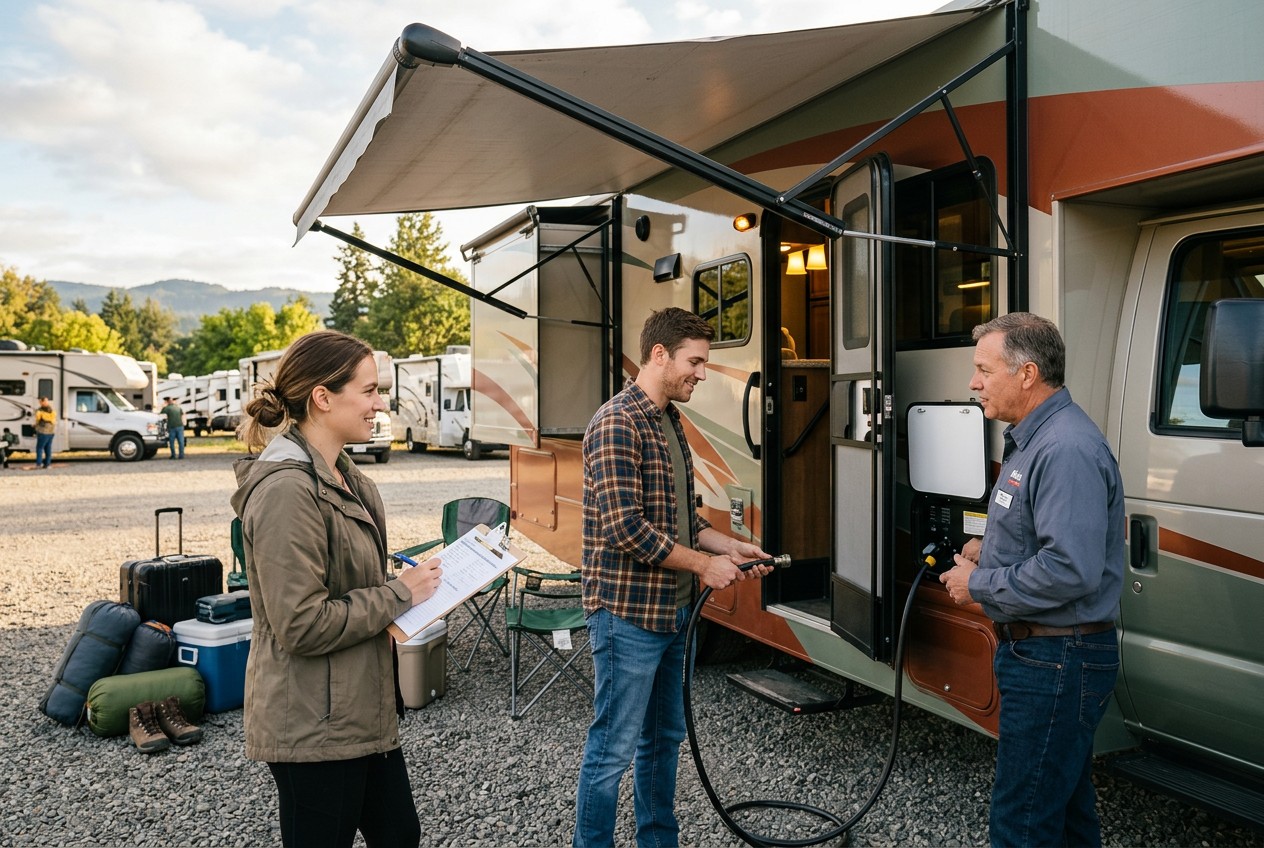
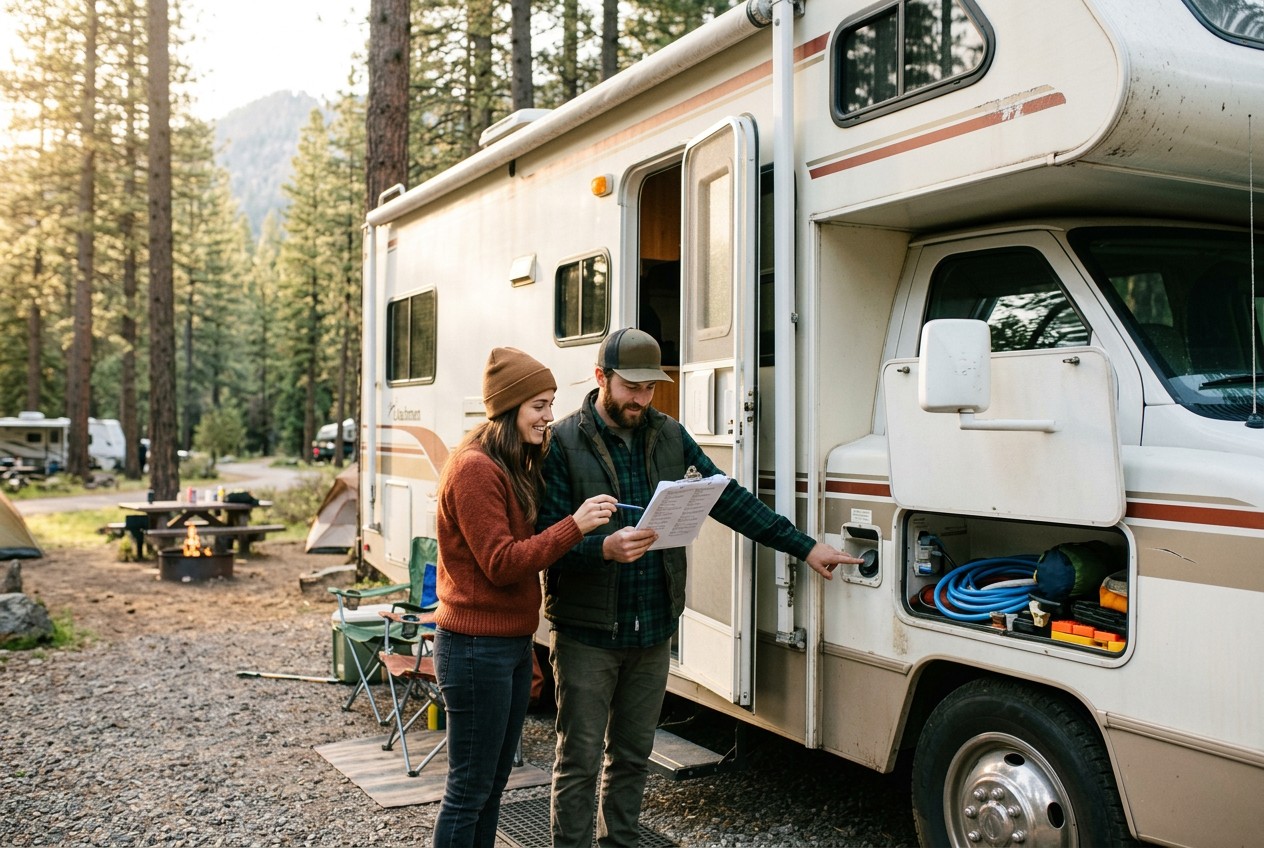
Allow enough pickup time to complete the RV walkthrough and pre-trip inspection before leaving. Do not rely on a quick verbal explanation. Operate each essential system yourself while the provider is present.
Use this checklist:
- Start the engine and review dashboard controls, mirrors, parking brake, transmission modes, and backup camera.
- Test the refrigerator, stove, microwave, heating, air conditioning, lights, outlets, and electrical control panel.
- Locate the propane shutoff and ask how to identify a leak or low supply.
- Test the water pump, faucets, toilet, shower, and fresh, gray, and black tank gauges.
- Identify the fresh-water connection, sewer outlet, electrical cord, adapters, leveling equipment, and wheel chocks.
- Practice operating slide-outs and the awning. Confirm required clearance and when they must remain retracted.
- Check doors, windows, storage compartments, locks, smoke detector, carbon monoxide detector, fire extinguisher, and emergency exits.
- Review safe driving procedures, RV height and length, fuel type, tire-pressure guidance, and any towing controls.
- Save the provider’s regular and after-hours contact numbers. Ask which problems require an immediate call and who may authorize repairs.
Confirm that manuals, roadside assistance instructions, registration documents, and insurance or protection-plan information are inside the RV.
Photograph the RV Condition and Readings
Create timestamped RV damage documentation before moving the vehicle. Take wide photos or video of every exterior side, then record close-ups of scratches, dents, cracked trim, damaged seals, and other existing defects.
Include:
- Front, rear, both sides, bumpers, mirrors, and visible roof areas
- Windshield, windows, lights, tires, wheels, awning, and slide-outs
- Cab, floors, furniture, countertops, appliances, bathroom, and storage areas
- Odometer or mileage reading
- Fuel and propane levels
- Fresh, gray, and black tank readings
- Generator-hour meter, if applicable
Ask the provider to acknowledge existing damage in the pickup report. Keep the files and written communications until the refundable security deposit has been released.
Set Up at the Campsite in a Safe Order
-
Position the RV. Check branches, utility posts, picnic tables, slopes, and slide-out clearance. Use a spotter when backing.
-
Secure the vehicle. Apply the parking brake, place the transmission in park, and install wheel chocks before leveling or connecting utilities.
-
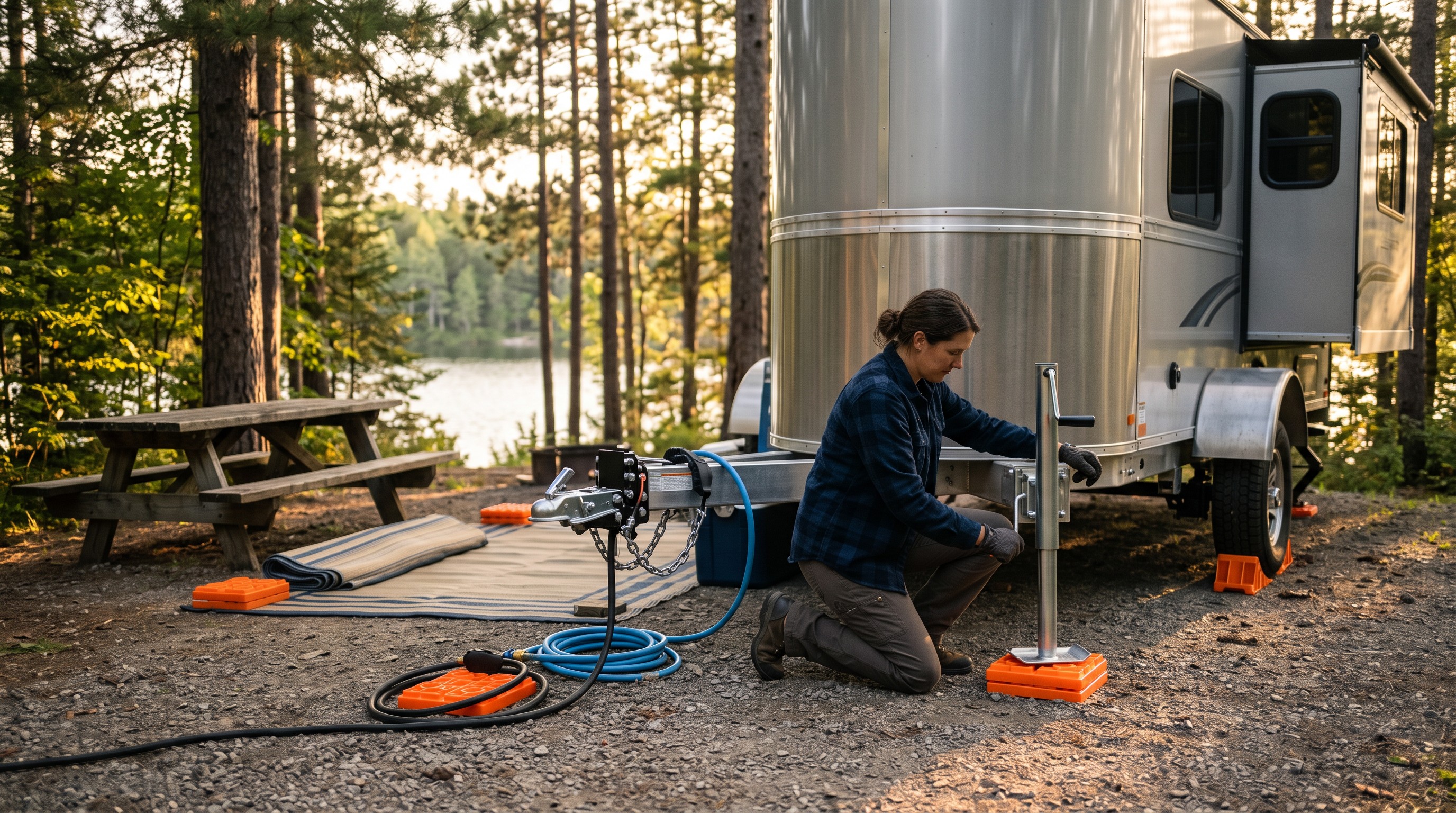
Level the RV. Follow the provider’s instructions for leveling blocks, stabilizers, or hydraulic equipment. Never use stabilizer jacks to lift a trailer unless specifically designed for that purpose.
-
Connect electricity. Turn off the campground pedestal breaker, inspect the outlet, connect the approved surge protector and power cord, then switch the breaker on.
-
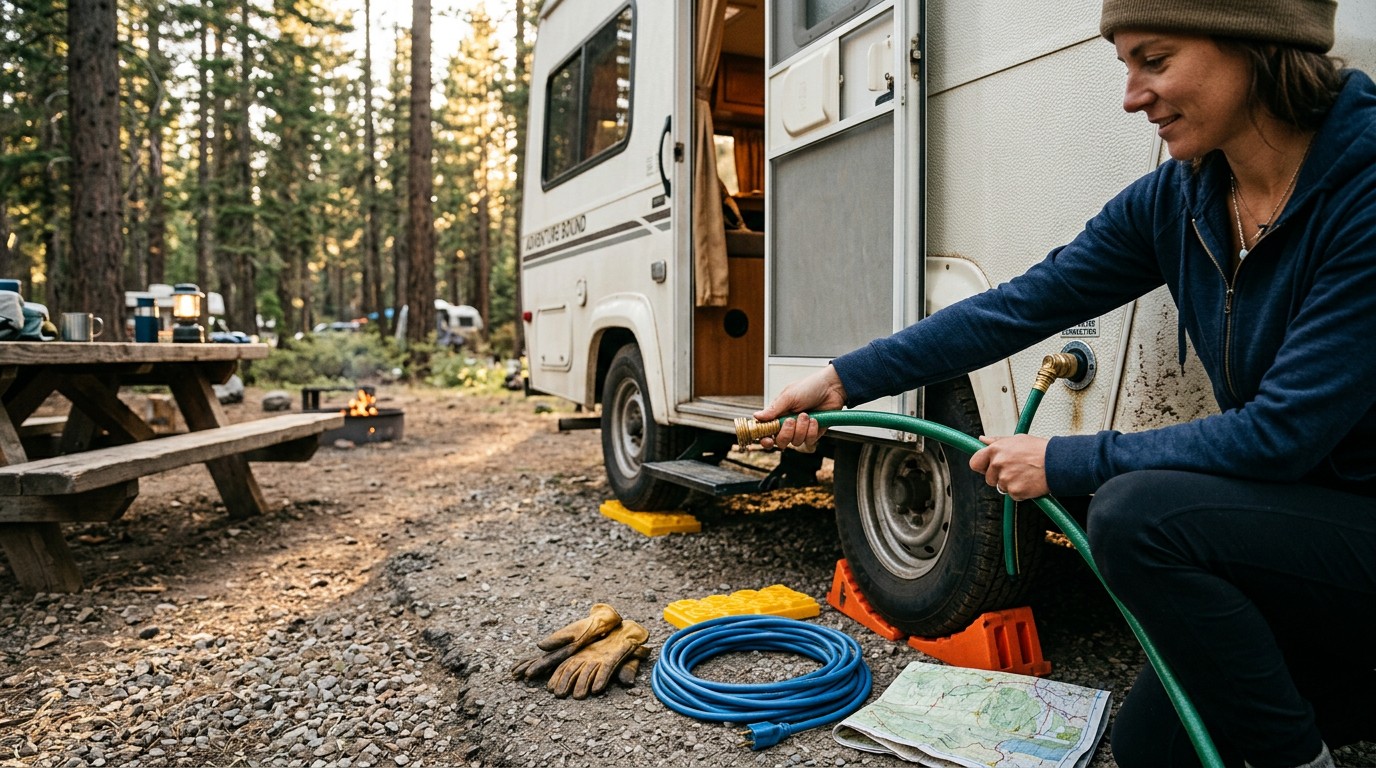
Connect water and sewer. Use the correct hoses, confirm tight fittings, and check for leaks. Keep wastewater valves positioned according to the provider’s instructions.
-
Extend slide-outs and awning. Recheck exterior clearance first. Retract the awning during strong wind or whenever the RV is unattended.
Finish by testing power, water flow, tank gauges, heating or cooling, and interior lights. If anything differs from the walkthrough, photograph it and contact the provider promptly.
Driving Pace, Trip Length, and Return-Day Checklist
Use the 3-3-3 or 4-4-4 Rule as a Flexible Guide
The 3-3-3 rule generally means driving no more than 300 miles per day, arriving by 3:00 PM, and staying three nights. The 4-4-4 version uses 400 miles, a 4:00 PM arrival, and a four-night stay.
These are optional pacing ideas, not rental requirements. A 300-mile RV day can take much longer than the same trip by car because of slower speeds, fuel stops, traffic, grades, and limited parking options.
Set the schedule around driver comfort, daylight, weather, campground check-in, and the needs of children, pets, or other passengers. For a first trip, a short route with one or two campgrounds is usually easier than changing sites every night.
Prepare the RV for Return
Review the provider’s current return terms at least one day before departure. Complete each required task:
- Refill fuel to the specified level.
- Refill propane only if the agreement requires it.
- Empty gray and black water tanks if required, allowing time for dump-station access.
- Complete the stated cleaning tasks without assuming the cleaning fee covers everything.
- Remove food, trash, and personal belongings.
- Return linens, hoses, cords, adapters, leveling equipment, keys, and other inventory.
- Retract the awning and slide-outs, close windows, secure cabinets, and lock storage compartments.
- Arrive before the scheduled return time.
- Report damage, warning lights, leaks, or mechanical problems immediately.
Fuel, propane, cleaning, dumping, and late-return policies vary by provider. Confirm the itemized charges and written terms directly rather than relying on general practice.
Document the Final Condition
Before handing over the keys, take timestamped photos or video of the exterior, interior, tires, windshield, awning, slide-outs, and equipment. Record the mileage, fuel level, propane level, generator hours, and fresh, gray, and black tank readings.
Photograph fuel, propane, and dump-station receipts. Keep the return inspection, messages, receipts, and rental agreement until the provider resolves the refundable security deposit and any damage claim.
First-Time RV Rental FAQ
How Much Does a Weekly RV Rental Cost?
Calculate the weekly total from the quoted weekly rate or seven nightly charges, then add:
- Excess mileage and generator hours
- Fuel
- Insurance or a protection plan
- Taxes and booking charges
- Campground reservations
- Cleaning and wastewater dumping
- Delivery, setup, pet, and equipment fees
Keep the refundable security deposit separate from the expected trip expense, although it increases the funds needed upfront. Use the RV Rental Cost Index for general comparisons, then confirm the current itemized quote and payment terms directly with the provider.
Do I Need a Special License or Separate Insurance?
License requirements can depend on the RV’s size and weight, the jurisdiction, and the provider’s rules. Many rentals may be driven with a standard driver’s license, but do not assume your chosen vehicle qualifies.
Before booking, confirm that each driver meets the provider’s age, license, and driving-record requirements. Ask whether insurance coverage is included, offered through a rental protection plan, or must be supplied separately. Review the deductible, coverage limits, exclusions, roadside assistance, authorized-driver rules, and claim procedure in writing.
Is an RV Hard to Drive, and How Long Should the First Trip Be?
Difficulty depends on the vehicle. A Class B camper van generally feels closest to driving a passenger van. Class C and Class A motorhomes require more attention to width, height, rear overhang, braking distance, and turning space. Travel trailers add towing, hitching, and backing skills.
For a first trip, consider a short route with limited daily mileage and one or two campgrounds. Reserve sites that fit the exact RV, and confirm hookup availability, check-in procedures, cancellation terms, and any campground deposit. A slower schedule leaves time for the pickup walkthrough, driving practice, campsite setup, and return tasks.
Generator safety: Never operate a generator in an enclosed or partially enclosed space. Keep exhaust away from doors, windows, vents, and neighboring campsites, follow all manufacturer and campground rules, and confirm that the RV’s carbon monoxide detector is working.
Propane safety: If you smell propane or suspect a leak, extinguish flames, do not operate electrical switches or create sparks, leave the RV immediately, and contact the rental provider or emergency services from a safe location. Shut off the propane supply only if you can do so safely.
Passenger safety: Every passenger must travel in an approved seating position with an appropriate seat belt or child restraint. Never allow anyone to ride in a bed, overhead bunk, trailer, or other unapproved location while the vehicle is moving.
Wastewater safety: Wear disposable gloves when handling sewer equipment, avoid splashes, wash your hands thoroughly afterward, and keep sewer hoses and fittings separate from drinking-water hoses and equipment.
Electrical safety: Do not connect to or attempt to repair a wet, damaged, loose, scorched, or overheated electrical pedestal, outlet, cord, adapter, or surge protector. Keep the breaker off and contact campground staff or the rental provider.
Legal requirements vary by location. Confirm current driver-license, towing, brake-controller, lighting, mirror, weight, passenger-restraint, road-access, and campground requirements for every jurisdiction on your route before departure.