
What Is a One-Way RV Rental?
A one-way RV rental, also called a one-way motorhome rental, lets you collect the vehicle at one RV pickup location and return it to a different RV drop-off location. This can eliminate backtracking on a regional route or cross-country RV trip.
How One-Way Rentals Work
You pick up the RV, complete an orientation and inspection, follow the approved route, and return it at the agreed location and time. The provider may limit available destinations because vehicles must be repositioned, serviced, or reserved for another renter.
One-way routes, dates, RV types, mileage allowances, and minimum rental periods vary by owner, fleet, and location. Confirm every detail in the written, itemized quote before booking.
One-Way vs Round-Trip RV Rental
| Factor | One-way rental | Round-trip rental |
|---|---|---|
| Return location | Different from pickup | Same as pickup |
| Route flexibility | Better for point-to-point trips | Better for loops |
| Return driving | Usually eliminated | Required |
| Mileage | May reduce total miles | Often adds return miles |
| Fees | May include a one-way drop fee | Usually no drop fee |
| Travel time | More time at destinations | More time spent backtracking |
Do not compare the drop fee alone. A round trip may require extra rental nights, fuel, paid mileage, campground stays, and meals. The advertised nightly rate is only one part of the all-in trip cost, so compare both itineraries using the same dates, mileage, and RV class.
RV Types and One-Way Availability
One-way availability depends on the vehicle, route, dates, and provider. Start with the RV Rental Compass directory and compare providers near the planned pickup and return points.
Class A, Class B and Class C Motorhomes
| RV type | Plain-English description | One-way considerations |
|---|---|---|
| Class A motorhome | A large, bus-shaped RV with substantial living and sleeping space | Comfortable for groups, but fuel use, parking, and driving difficulty can be higher |
| Class B camper van | A compact motorhome built inside a van body | Easier to drive and park, but storage, beds, and bathroom space are limited |
| Class C motorhome | A truck-based RV with a sleeping area above the cab | A practical middle ground for families, with more room than a van and easier handling than many Class A models |
Motorized RVs are generally the most practical choice for point-to-point travel. However, a particular vehicle may still be restricted to round trips or approved drop-off locations.
Travel Trailers and Delivered RVs
A travel trailer must be towed by a properly equipped vehicle. You also need permission to leave the trailer elsewhere and a plan for returning or relocating the tow vehicle. These complications make standard one-way trailer rentals relatively uncommon.
For a trip centered on one campground, a delivered RV may be simpler. The provider transports the unit and may handle setup, but delivery and setup fees can apply. Confirm the service area, campground access requirements, pickup timing, and whether tanks, hookups, or cleaning are included.
Fleet Rentals, Peer-to-Peer Listings and Relocation Deals
Fleet operators may offer scheduled one-way routes between established locations. Peer-to-peer owners usually approve requests individually, so availability can depend on who retrieves the RV after your trip.
A relocation deal pays or discounts the renter to move an RV where it is needed. These offers can have narrow dates, fixed destinations, limited mileage, and short minimum or maximum rental periods. Confirm the exact route, included miles, protection terms, deposit, and all fees directly with the provider before booking.
What Does a One-Way RV Rental Really Cost?
Nightly Rate vs All-In Trip Cost
A hypothetical advertised rate of $180 per night produces $1,260 in base rent for seven nights. This is arithmetic, not a typical-rate claim or local quote; the actual trip budget can be much higher after adding the one-way fee, mileage, protection, taxes, fuel, and overnight stays.
This example is illustrative, not a local quote:
| Cost item | Example calculation | Estimated cost |
|---|---|---|
| Advertised nightly rate | 7 nights x $180 | $1,260 |
| One-way drop fee | Fixed charge | $650 |
| Excess mileage | 800 miles x $0.45 | $360 |
| Generator overage | 6 hours x $4 | $24 |
| Protection plan | 7 days x $35 | $245 |
| Rental taxes | Illustrative estimate | $250 |
| Cleaning fee | Fixed charge | $125 |
| Fuel | Estimated for the route | $525 |
| Campgrounds | 6 nights x $55 | $330 |
| Optional extras | Linens or kitchen kit | $90 |
| Estimated all-in trip cost | $3,859 |
The nightly rental portion is only $1,260, but the estimated all-in trip cost is $3,859. Mileage, fuel, campground charges, and generator use depend on the actual itinerary and renter behavior.
Some charges are prepaid at booking. Others, including excess mileage, generator overages, refueling, cleaning adjustments, or damage-related amounts, may be settled after return. Use the RV rental cost guide to identify common expenses, then test the route with the RV rental cost calculator.
Is the One-Way Drop Fee Worth Paying?
Compare the drop fee with the cost of returning the RV to its starting point. A round trip could add two rental days, 700 miles, fuel, paid mileage, two campground nights, meals, and 12 or more hours of driving.
For example, a $650 drop fee may look expensive in isolation. However, if backtracking adds $360 in rental nights, $250 in fuel, $140 in mileage charges, $110 in campgrounds, and $80 in meals, the return journey already costs $940 before valuing your time.
Calculate both complete itineraries using the same RV type, dates, planned stops, and mileage assumptions.
Deposits and Optional Service Fees
A refundable security deposit is not normally part of the final trip cost unless the provider retains an authorized amount under the rental agreement. It can still affect available credit or cash. Confirm when the deposit is authorized or collected, what deductions are permitted, and how long release may take after inspection.
Possible nonrefundable charges include:
- Delivery and setup
- Cleaning
- Linens and kitchen kits
- Pet fees
- Late-return fees
- Refueling or propane service
Not every provider charges every fee. Prices, taxable items, deposit rules, and policies vary by owner, fleet, and location. Request a current itemized quote and confirm which amounts are prepaid, estimated, refundable, or due after return before booking.
Mileage, Generator Hours and Fuel Charges
Included Mileage and Mileage Packages

Mileage may be included as a daily allowance, a total trip allowance, or a prepaid package. Estimate your needs before comparing quotes:
- Map the approved route from pickup to drop-off.
- Add miles for campgrounds, fuel stops, groceries, attractions, and planned side trips.
- Add a 10-15 percent buffer for detours and navigation changes.
- Subtract the included mileage from the estimated total.
- Multiply any remaining miles by the quoted excess mileage charge.
For example, a 1,200-mile route with a 15 percent buffer becomes 1,380 estimated miles. If the rental includes 1,000 miles, compare the cost of 380 excess miles with the provider’s prepaid mileage package.
Unlimited Mileage and Excess Mileage Charges
Unlimited mileage can simplify budgeting, but read the restrictions. An offer may apply only to certain vehicles, dates, routes, or minimum rental periods. It may also exclude local driving outside the approved one-way itinerary.
Compare offers using the same estimated distance:
| Quote type | Calculation |
|---|---|
| Mileage allowance | Base rental cost + excess miles x per-mile charge |
| Prepaid package | Base rental cost + package price + uncovered excess miles |
| Unlimited mileage | Base rental cost + unlimited-mile surcharge, if any |
The lowest advertised nightly rate may not produce the lowest all-in trip cost. Confirm the included miles, package refund policy, odometer procedure, and excess mileage rate in the itemized quote.
Generator-Hour Allowances and Fuel Policies
Motorhomes may include a set number of generator hours per day or trip, followed by a per-hour charge. Air-conditioning, off-grid camping, and operating appliances without hookups can increase use. Record the generator meter during pickup and return inspections.
Also verify:
- Required fuel level at return
- Propane refill requirements
- Refueling or propane service charges
- Approved fuel type
- Generator fuel source
- Whether roadside fuel delivery is included in assistance
Fuel and propane policies vary by owner, fleet, vehicle, and location. Confirm current terms directly with the provider before booking.
Planning a Realistic One-Way RV Route
Daily Driving Limits and the RV 3-3-3 Rule
RV travel usually takes longer than the same route by car. Acceleration is slower, fuel stops require more space, and wind or mountain grades can make driving tiring.
The RV 3-3-3 rule is a useful planning guideline:
- Drive no more than about 300 miles per day
- Arrive at the campground by 3:00 PM
- Stay for at least three nights before moving again
You do not need to follow it exactly. For a one-way trip with fixed dates, aim for four to six hours of driving on most travel days. Add time for fuel, meals, rest breaks, grocery stops, campground check-in, hookups, and unexpected delays.
Map each travel day before booking. A 1,500-mile route covered in five days requires an average of 300 miles daily, but sightseeing detours and city traffic can quickly make that schedule demanding.
Campgrounds, Overnight Stops and Reservations
Choose stops that can accommodate the RV’s total length, not just the living area. A campground suitable for a Class B camper van may not fit a 35-foot Class A motorhome. Confirm:
- Maximum RV length
- Electric, water, and sewer hookups
- Check-in and quiet-hour rules
- Pull-through or back-in site type
- Road grades, bridge clearances, and access restrictions
- Cancellation terms and late-arrival procedures
Add campground fees to the all-in trip cost. Rates vary substantially by location, season, site type, and amenities, so use current prices from each campground instead of relying on a national average.
Do not assume that a parking lot, roadside area, or public land is a legal or suitable overnight stop. Rules, access, security, and RV size restrictions vary. Reserve important stops early during holidays and peak travel seasons.
Flights, Airports and Rental Depots
An RV pickup location may be many miles from the airport. Before buying flights, confirm the depot address, transportation options, operating hours, required pickup window, and estimated orientation time.
Avoid scheduling RV pickup immediately after a late flight. Delays could cause you to miss the handover window, and first-time renters may need an hour or more for paperwork, inspection, and vehicle instruction. A hotel near the airport or depot may provide a safer buffer.
Apply the same caution at the RV drop-off location. Allow time for tank dumping, refueling, cleaning, inspection, ground transportation, and traffic. An early flight immediately after RV return creates unnecessary risk.
How to Compare Quotes and Book Safely
Itemized RV Rental Quote Checklist
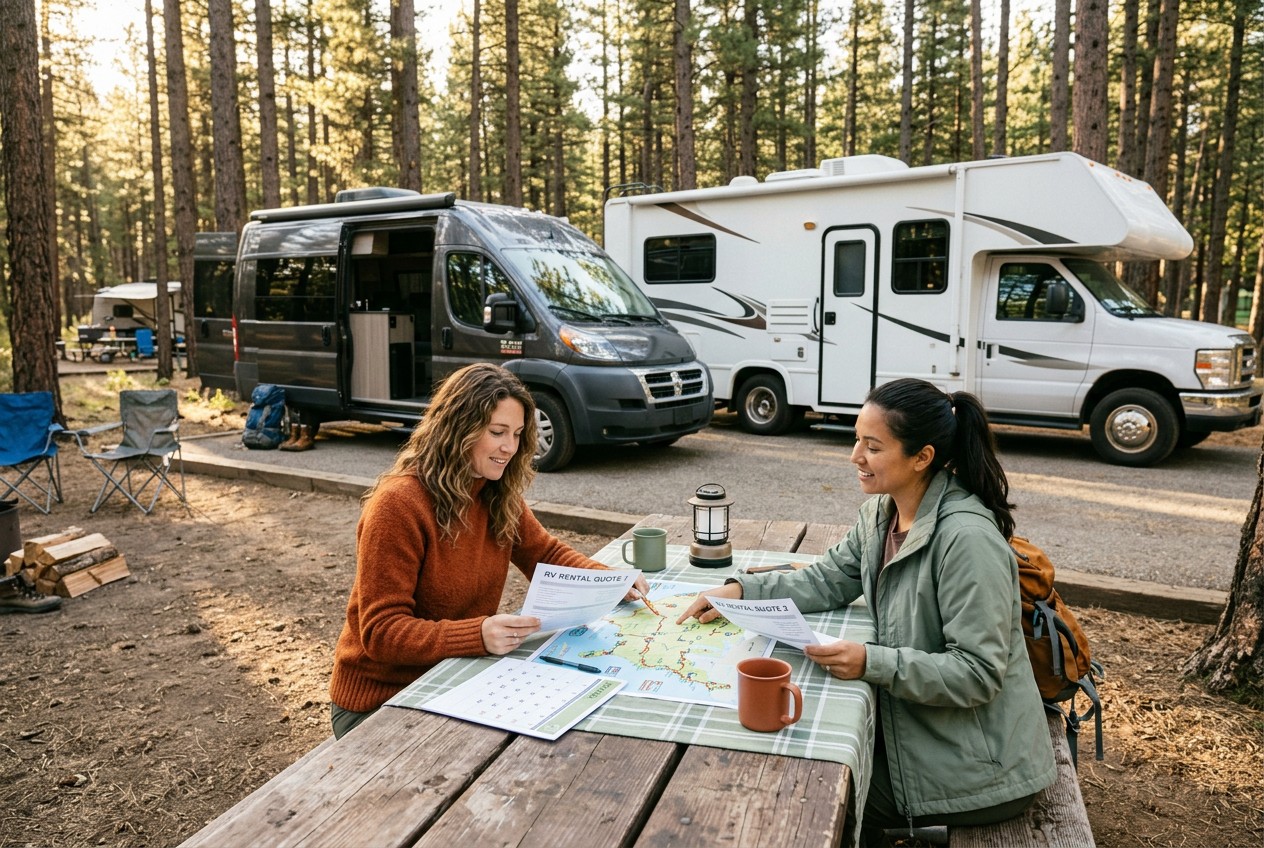
Compare quotes for identical dates, pickup and drop-off locations, approved route, and RV class. A Class B camper van quote is not directly comparable with a larger Class C or Class A motorhome.
Ask each provider for a written breakdown covering:
- Advertised nightly rate and minimum rental period
- One-way drop fee
- Included mileage, prepaid packages, and excess mileage charge
- Included generator hours and overage rate
- Insurance or protection-plan cost
- Rental taxes
- Cleaning, delivery, and setup fees
- Linens, kitchen kits, and pet charges
- Fuel and propane return requirements
- Refundable security deposit
- Late-return charges and grace periods
- Estimated campground costs for the planned route
Separate prepaid rental charges from variable expenses settled after return. The lowest nightly rate may produce a higher all-in trip cost once mileage, protection, taxes, and fees are included.
Insurance, Protection Plans and Roadside Assistance
Insurance is a regulated insurance product, while a provider protection plan may be a contractual damage-waiver arrangement. The names and coverage vary, so do not assume either option covers every accident, vehicle component, driver, or use.
Verify these terms in writing:
- Deductible or renter responsibility amount
- Coverage limits and exclusions
- Approved and excluded drivers
- Geographic or road restrictions
- Prohibited uses, including unauthorized towing
- Coverage for windshield, tire, roof, undercarriage, and interior damage
- Personal-property and liability provisions
- Claim reporting deadlines
Roadside assistance may cover dispatch without covering every repair, tow, tire, hotel, or replacement vehicle. Ask who must authorize repairs, where the RV may be towed, and what happens if a breakdown disrupts the one-way itinerary. Confirm whether lodging, alternate transportation, unused rental days, or a changed drop-off location receive any reimbursement.
Deposits, Inspections and Policy Changes
A refundable security deposit may be authorized on a credit card, collected before pickup, or charged separately. Confirm the amount, permitted deductions, release timing, and procedure for disputing a charge.
At pickup and return:
- Take timestamped photos and video of every side, the roofline from ground level where visible, interior, appliances, tires, and windshield. Do not climb onto the roof.
- Record existing damage on the inspection form before departure.
- Photograph the odometer, fuel gauge, propane level, and generator-hour meter.
- Document tank status, included equipment, and cleanliness.
- Obtain written confirmation of the final return condition.
Read the cancellation, route-change, breakdown, and delayed-return policies before paying. A missed return window or unauthorized destination change can create added costs and interfere with flights or lodging. Prices, exclusions, deposits, and policies vary by owner, fleet, and location, so confirm the current itemized quote and complete rental terms directly with the provider before booking.
When Another Travel Option Costs Less
Round Trip or One-Way?
Compare complete itineraries, not just the one-way drop fee. A round trip may avoid that fee but add rental days, paid mileage, fuel, campground nights, meals, and hours of return driving.
| Option | Costs to include |
|---|---|
| One-way RV | Nightly rate, drop fee, mileage, fuel, protection, taxes, campgrounds, and transportation from the drop-off location |
| Round-trip RV | Extra rental nights, return mileage, fuel, protection, taxes, campgrounds, meals, and added travel time |
If a $600 drop fee replaces two extra rental nights plus 500 miles of backtracking, the one-way option may cost less overall. Use the RV rental cost calculator with the same dates, RV type, and route assumptions for both choices.
Delivered RV or Hotel Plus Rental Car?
A delivered RV can suit a trip based at one campground. The provider transports and may set up the unit, so you avoid driving a motorhome. Include delivery, setup, campground, cleaning, and tank-service charges.
Hotels plus a rental car may be less expensive or simpler for a long route with frequent city stops. Compare hotel rates, car rental, fuel, parking, meals, and resort or destination fees against the RV’s all-in cost. RV travel adds campground fees and fuel, but a kitchen may reduce restaurant spending.
A Simple Booking Decision
Choose the option that best balances:
- Total trip cost after every fee
- Point-to-point convenience
- RV size and driving comfort
- Campground or hotel availability
- Mileage and generator limits
- Deposit, cancellation, breakdown, and route-change risk
Prices, routes, availability, and policies vary by owner, fleet, and location. Before paying, request an itemized quote and confirm current terms directly with the provider.
One-Way RV Rental FAQ
Can I Find a One-Way RV Rental Near Me?
Search the RV Rental Compass directory for pickup options. Then verify approved drop-off locations, travel dates, RV type, route restrictions, and minimum rental period directly with the provider. Local availability can change by season and fleet needs.
Do One-Way RV Rentals Include Unlimited Miles?
Some offers include unlimited mileage. Others provide a daily or trip allowance, sell prepaid mileage packages, or charge for excess miles. Check for route, vehicle, date, and minimum-stay restrictions. The written, itemized quote controls.
Are Relocation Deals or Hotels Usually Cheaper?
Relocation deals may reduce the rental rate or drop fee, but they often have fixed routes, narrow travel dates, mileage limits, and short schedules. Compare the complete terms with a standard rental.
Also calculate hotels plus a rental car, including lodging, fuel, parking, meals, and destination fees. Confirm current prices, deposits, protection costs, taxes, and policies before booking.
Safety: Follow the rental provider’s orientation, the vehicle manufacturer’s instructions, posted restrictions, and all applicable traffic, parking, camping, towing, and licensing laws. If you are unsure how to operate any RV system, ask the provider before use.
Generator safety: Never operate a generator in an enclosed or poorly ventilated area or where exhaust can enter the RV. Keep working carbon monoxide alarms in the vehicle and follow all manufacturer clearance and ventilation requirements.
Driving safety: Every occupant must travel in a designated seat with an appropriate seat belt while the RV is moving. Adjust the route and schedule for driver experience, fatigue, weather, vehicle dimensions, weight limits, braking distance, and road conditions.
Propane, fuel, electrical, and wastewater systems can cause fire, poisoning, electric shock, burns, or contamination if handled incorrectly. Use only approved equipment and facilities, and follow the provider’s instructions at all times.
Do not climb onto an RV roof unless the manufacturer and rental provider expressly permit it and safe access equipment is available.
Sources and verification
- USA.gov state motor vehicle services links to official state agencies for driver-license, registration and route-specific vehicle-rule questions.
- NHTSA Vehicle Safety provides federal safety and recall resources for checking a specific vehicle.
- NAIC state insurance department directory links to official state insurance regulators.
These sources support the state-rule, vehicle-safety and insurance-regulator context above. They do not validate a one-way route, relocation fee, rental rate, vehicle, provider, availability, protection plan or specific policy; verify written terms directly.